
personal_ai_infrastructure
💡 Summary
PAI is a personalized AI platform designed to enhance individual capabilities through continuous learning and goal orientation.
🎯 Target Audience
🤖 AI Roast: “It's like a motivational speaker, but for your AI.”
The README suggests potential risks such as dependency supply chain vulnerabilities and user data exposure. To mitigate these risks, ensure regular updates and audits of dependencies.
Personal AI Infrastructure




















Overview: Purpose · What is PAI? · New to AI? · Principles · Primitives
Get Started: Installation · Releases · Packs · Bundles
Resources: FAQ · Roadmap · Community · Contributing
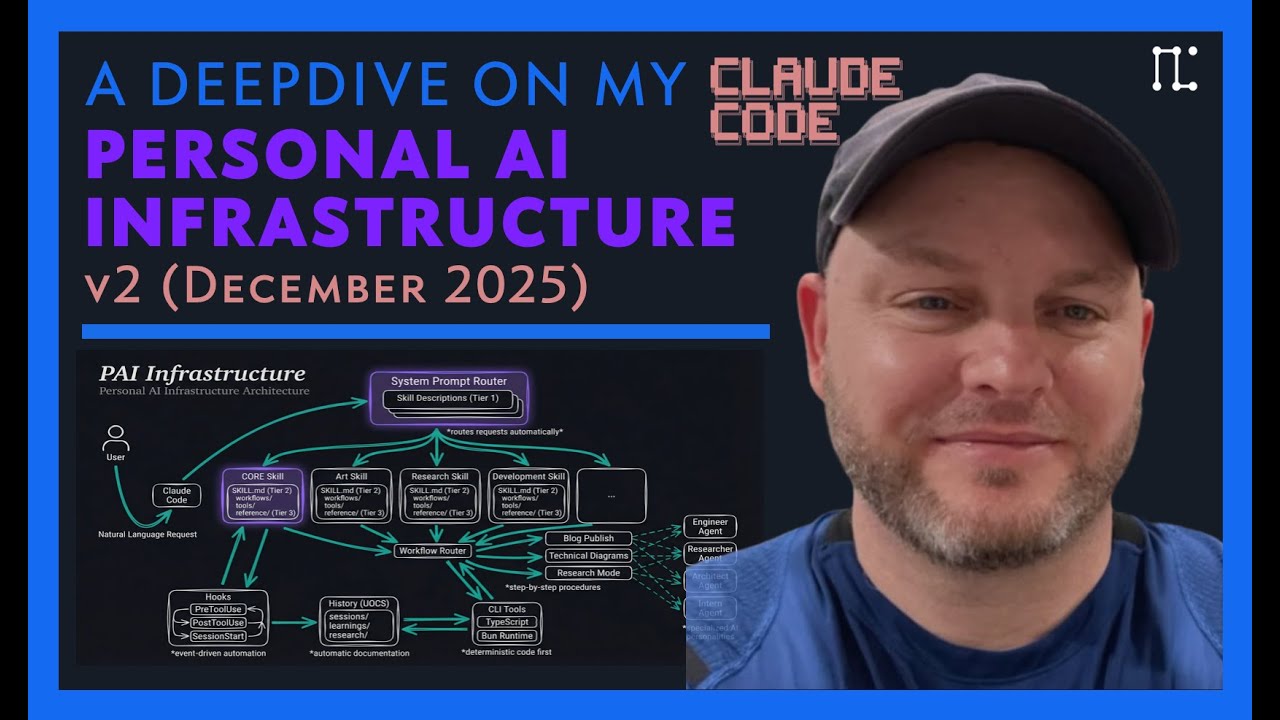
Watch the full PAI walkthrough | Read: The Real Internet of Things
[!IMPORTANT] PAI v2.5.0 Released — Think Deeper, Execute Faster: Two-Pass Capability Selection, Thinking Tools with Justify-Exclusion, and Parallel-by-Default Execution.
AI should magnify everyone—not just the top 1%.
The Purpose of This Project
PAI exists to solve what I believe is the P0 problem in the world:
Only a tiny fraction of humanity's creative potential is activated on Earth.
Most people don't believe they have valuable contributions to make. They think there are "special" people—and they aren't one of them. They've never asked who they are, what they're about, and have never articulated or written it down. This makes them catastrophically vulnerable to AI displacement. Without activation, there is no high-agency.
So our goal with PAI is to activate people.
PAI's mission is twofold:
- Activate as many people as possible — Help people identify, articulate, and pursue their own purpose in life through AI-augmented self-discovery
- Make the best AI available in the world accessible to everyone — Ensure this quality of AI infrastructure isn't reserved for just the rich or technical elite.
That's why this is an open-source project instead of private.
New to This? Start Here
You've probably used ChatGPT or Claude. Type a question, get an answer. Simple.
You can think of AI systems as three levels:
Chatbots
ChatGPT, Claude, Gemini—you ask something, it answers, and then it forgets everything. Next conversation starts fresh. No memory of you, your preferences, or what you talked about yesterday.
The pattern: Ask → Answer → Forget
Agentic Platforms
Tools like Claude Code, Cursor, and Windsurf. The AI can actually do things—write code, browse the web, edit files, run commands.
The pattern: Ask → Use tools → Get result
More capable, but it still doesn't know you—your goals, your preferences, your history.
PAI (Personal AI Infrastructure)
Now your DA learns and improves:
- Captures every signal — Ratings, sentiment, verification outcomes
- Learns from mistakes — Failures get analyzed and fixed
- Gets better over time — Success patterns get reinforced
- Upgrades itself — Skills, workflows, even the core behavior evolves
Plus it knows:
- Your goals — What you're working toward
- Your preferences — How you like things done
- Your history — Past decisions and learnings
The pattern: Observe → Think → Plan → Execute → Verify → Learn → Improve
The key difference: PAI learns from feedback. Every interaction makes it better at helping you specifically.
What is PAI?
PAI is a Personalized AI Platform designed to magnify your capabilities.
It's designed for humans most of all, but can be used by teams, companies, or Federations of Planets desiring to be better versions of themselves.
The scale of the entity doesn't matter: It's a system for understanding, articulating, and realizing its principal's goals using a full-featured Agentic AI Platform.
Who is PAI for?
Everyone, full stop. It's the anti-gatekeeping AI project.
- Small business owners who aren't technical but want AI to handle invoicing, scheduling, customer follow-ups, and marketing
- Companies who want to understand their data, optimize operations, and make better decisions
- Managers who want to run their teams more effectively—tracking projects, preparing for reviews, and communicating clearly
- Artists and creatives who want to find local events, galleries, and opportunities to showcase their work
- Everyday people who want to improve their lives—better fitness routines, stronger social connections, personal finance, or just getting organized
- Developers using AI coding assistants who want persistent memory and custom workflows
- Power users who want their AI to know their goals, preferences, and context
- Teams building shared AI infrastructure with consistent capabilities
- Experimenters interested in AI system design and personal AI patterns
What makes PAI different?
The first thing people ask is:
How is this different from Claude Code, or any of the other agentic systems?
Most agentic systems are built around tools with the user being an afterthought. They are also mostly task-based instead of being goal-based using all the context available to them. PAI is the opposite.
Three core differentiators:
-
Goal Orientation — PAI's primary focus is on the human running it and what they're trying to do in the world, not the tech. This is built into how the system executes all tasks.
-
Pursuit of Optimal Output — The system's outer loop and everything it does is trying to produce the exact right output given the current situation and all the contexts around it.
-
Continuous Learning — The system constantly captures signals about what was done, what changes were made, what outputs were produced for each request, and then how you liked or disliked the results.
The PAI Principles
These principles guide how PAI systems are designed and built. Full breakdown →
| # | Principle | Summary | |---|-----------|---------| | 1 | User Centricity | PAI is built around you, not tooling. Your goals, preferences, and context come first—the infrastructure exists to serve them. | | 2 | The Foundational Algorithm | The scientific method as a universal problem-solving loop: Observe → Think → Plan → Build → Execute → Verify → Learn. Define the ideal state, iterate until you reach it. | | 3 | Clear Thinking First | Good prompts come from clear thinking. Clarify the problem before writing the prompt. | | 4 | Scaffolding > Model | System architecture matters more than which model you use. | | 5 | Deterministic Infrastructure | AI is probabilistic; your infrastructure shouldn't be
Pros
- Empowers users to articulate personal goals.
- Continuous learning enhances user experience.
- Accessible to a wide range of users.
Cons
- May require a learning curve for new users.
- Complexity might overwhelm some users.
- Dependence on user input for effectiveness.
Related Skills
freshbooks-speed
A“Powerful, but the setup might scare off the impatient.”
Disclaimer: This content is sourced from GitHub open source projects for display and rating purposes only.
Copyright belongs to the original author danielmiessler.